Category
Collaborations
Publish Date
07 Feb 2026
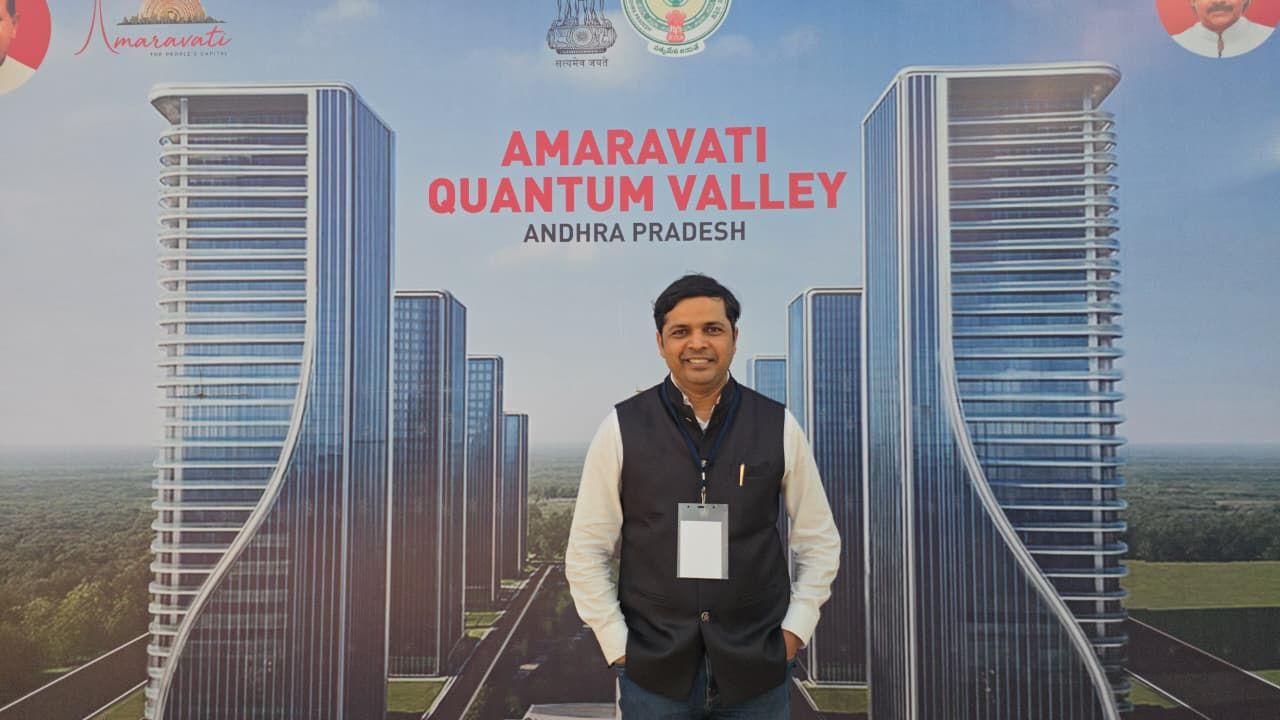
Qute Electronics signed a Memorandum of Understanding (MoU) with the Amaravati Quantum Computing Center (AQCC), Government of Andhra Pradesh, under the Amaravati Quantum Valley initiative.
Through this collaboration, we will work together to build indigenous electronic systems and cryogenic instrumentation for different types of quantum computers, including:
• Superconducting qubits
• Ion-trap and trapped-electron qubits
• Spin qubits
• Semiconductor and CMOS-based qubits
Qute Electronics will contribute low-noise ultra-precision voltage and current sources, RF and microwave control electronics, fast high-voltage switching systems, and cryogenic amplifiers.

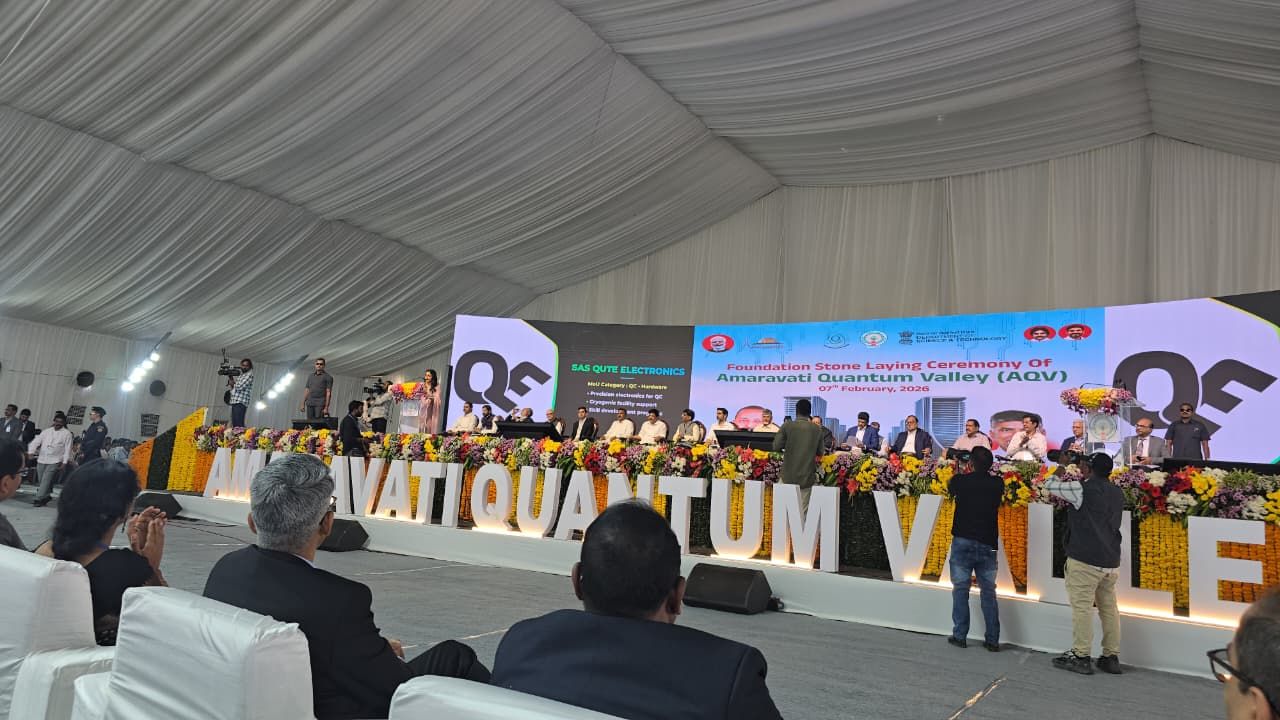
The MoU was signed during the foundation stone ceremony of Amaravati Quantum Valley, in the presence of Nara Chandrababu Naidu – Hon’ble Chief Minister of Andhra Pradesh, Dr. Jitendra Singh – Hon’ble Union Minister of State (Independent Charge) for Science & Technology, Government of India, Abhay Karandikar – Secretary, Department of Science & Technology (DST), Government of India, Ajay Kumar Sood – Principal Scientific Adviser to the Government of India.
We thank the Government of Andhra Pradesh and AQCC for their confidence and support.
India’s quantum hardware journey is accelerating - and we are proud to be part of it.

A city made India's boldest quantum move in 2025. Amaravati's Quantum Valley announcement — anchored by IBM's largest quantum system planned for India — signaled that India's quantum ambition is no longer just federal. States are now in the race. And at the national level, the story gets even bigger.
India's National Quantum Mission — NQM is no longer a promise on paper. It's infrastructure, institutional ownership, and real milestones in motion 🇮🇳. Four Thematic Hubs anchored at India's premier institutions are now operational — each owning a distinct vertical across computing, communication, sensing, and materials. This isn't scattered research. It's a coordinated national strategy with accountability built in.
2026 could be India’s quantum inflection point.
If timelines hold, the shift may move from building infrastructure to demonstrating capability.
Indigenous processors benchmarked.
Quantum communication on live networks.
Early commercial signals from startups.
If execution matches ambition, the question may shift from "Is India serious?" to "How fast is India moving?"
Where QUTE fits in: QUTE's contribution to NQM goes beyond research participation. By focusing on quantum talent development and bridging academia with real-world application, QUTE addresses the layer most missions underinvest in. In a field where the global talent shortage is as critical as the technology gap itself, that role isn't peripheral. It's foundational.
2026 is where intent becomes proof. Is India ready to deliver? Drop your perspective on our Linkedin — what do you think India's biggest quantum breakthrough of 2026 will be?